Continuing your Sock Knitting Journey

Note from the SpaceCadet:  My friend Amy (DPUTiger on Ravelry) is a knitting teacher, a quilter, and a newly-minted weaver.  And she’s been kind enough to write a series of posts about her favourite ways to start new sock knitters on their journey…

So you’ve tackled Fuzzy Feet and are ready to move along and try something else. Where is a good place to start with that beautiful fingering weight yarn and the toothpick-sized needles?

My first pair of fingering weight socks were generated by my sock class teacher with Sock Wizard.  They had crazy-long cuffs (hello, 7” of 2×2 ribbing!) and took a really, really long time to knit. I did a second pair with the same yarn, on needles that I hated, and with short-row heels and toes.  That experience nearly put me off of socks completely.

.

.

So, you ask, what turned things around for me, and what would I recommend to you so you don’t suffer the sock blahs right out of the gate?

Knitting Rules.  If you aren’t familiar with Stephanie Pearl-McPhee, aka the Yarn Harlot, you should be. Stephanie is a terrific writer with a sense of humour.  And whether you are an experienced knitter or especially a knitter that’s just starting to branch out into the world of Not Scarf Knitting, Knitting Rules is a valuable addition to any knitter’s library.

So just as I was finishing the Socks from Hell, the Yarn Harlot began blogging about the step-out socks that she was knitting for an appearance on Knitty Gritty. I was intrigued, picked up a copy of Knitting Rules and hit the jackpot.

And while Stephanie provides a perfectly awesome 64-stitch sock pattern, she also provides a good basic sock recipe. I love this pattern and recommend it because it gives you the tools to create a sock in any size to fit any foot. She gives you permission to stockingette that leg after a couple inches of ribbing. She has great information on how to start with hats, sweaters, all kinds of things. The book is a great foundation for wherever you want to take your knitting.

There are a few little tidbits I’ll throw in before I leave you in suspense waiting for my final salvo on sock knitting:

  • I have one rule in my classes: No Eeyores.  If you attack something new with a positive, can-do attitude, you will succeed!  If you are convinced sock knitting is too hard for you, then it will be.  Period.  Attitude is a self-fulfilling prophecy.
  • Lifelines are your friend!  (What is a lifeline? Click here)  If you’re new to sock knitting, throw a lifeline in before you start something new. My ideal lifeline material is DMC Perle Cotton, commonly used for cross stitch and embroidery. If you use lifelines, you really can knit fearlessly, because it will be simple to rip out and re-start if you screw up or get confused.
  • Every single sock pattern in existence can be knit using any of the three small-circumference knitting methods: double-pointed needles (DPNs), two circular needles, or the Magic Loop.  All three methods are interchangeable.  Always.  No exceptions.

I’ll be back again to discuss the one book that changed my knitting life. Until then, enjoy your foray into sock knitting!
An Open Letter

An Open Letter to Those who Don’t Get the Fiber Arts

I am not doing this to recreate the past.  I don’t harbour any fantasies of wearing petticoats or a bonnet.   And I don’t knit because I want to feel domestic.

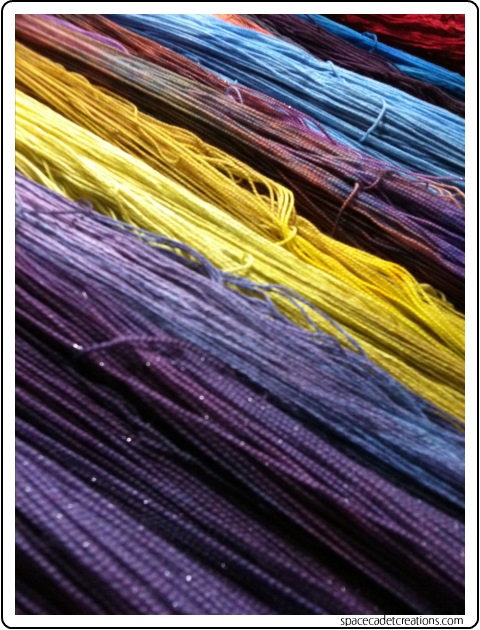
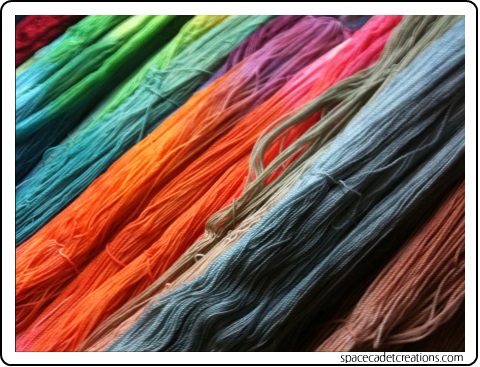
I do this to free my soul.  I do this to work in colours that make my heart sing.   I dye because I see in my mind hues and shades that are bursting to be let out.  And so I do let them out, laying them down in dye upon fiber – vibrant shades poured out over wool, over silk, over the ordinary of life.

SpaceCadet Yarn 2

And when, at last, I cast those colours onto my needles, I feel a calm wash over me as I work them up into a fabric of my own making — the needles clicking softly and the colours gently blending and contrasting.

I know you think this is old-fashioned, but it’s not.  It is as modern as imagination, as current as discovery, as now as creativity.  Would you ask a painter why he doesn’t just take a photograph?

And it’s ok if you don’t get it.  I understand.  But I just wanted to say – I just wanted to say out loud – that this is nothing about old fashioned.  This is what I do, and I do it now.  I am a fiber artist.

SpaceCadet Yarn 1


Pattern Roll-Call: Trifecta Perfection

There’s snow on the ground and ice on the way, and the wind is bitter and cruel.  I think no month can be called Deep Winter more than February, and it takes all our woolly armory to stave off the cold.

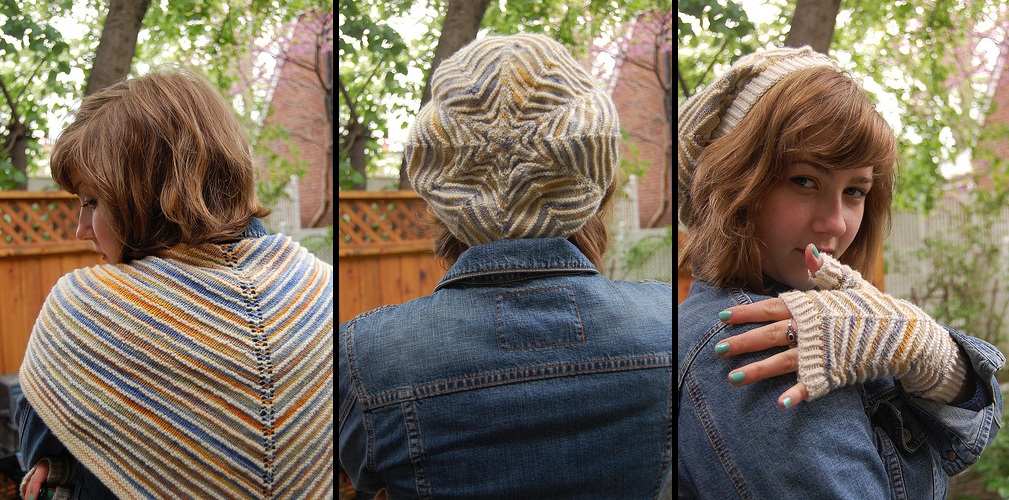
So when I saw the Sweetly Worn trio by Natalie Selles, I knew I had to show it to you.  I mean, it caught my eye first because of the way it will show off a hand-dyed variegated yarn so beautifully by alternating it against contrasting solid yarn.   And I love that the stripes travel across the fabric to form intriguing shapes and angles.

© Natalie Selles, Used with Permission

.

But today,on this cold, grey, snow-locked February day, I think I just really love the fact that this is a complete set — hat, shawl, and mitts — that will go a long way toward keeping this bone-chilling winter at bay.

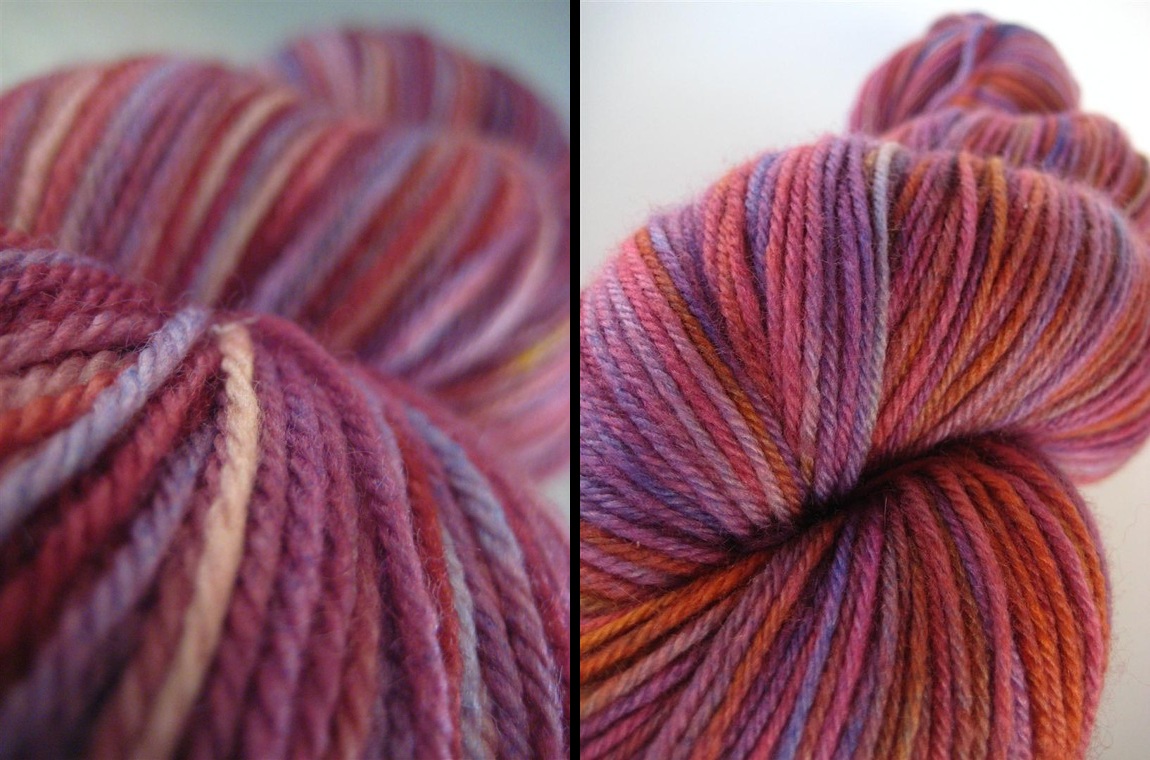
I think this pattern would look wonderful with a deep, wintery colourway such as this Celeste in Stewed Cranberries (which went into the shop today) or Estelle in Spice Trade:

sock yarn, yarn, knitting, hand-dyed
Celeste in Stewed Cranberries, Estelle in Spice Trade

.

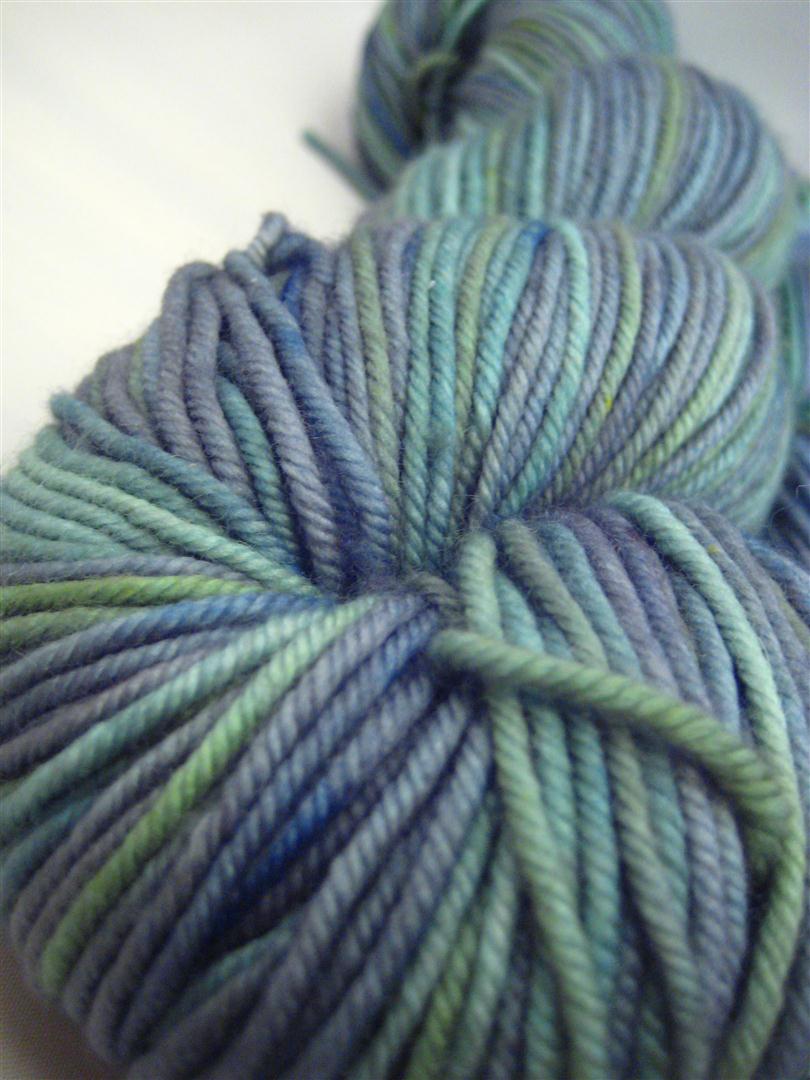
Or, if you are looking out at the snow and find yourself in need of a boost of bright summery colour, perhaps you could try these zesty yellows and greens that I’ve just put into the Dept of Rocket Science:

knitting, yarn, sock yarn
Estelle and Stella in Dept of Rocket Science 110120-010

A First Step in Sock Knitting

Note from the SpaceCadet:  My friend Amy (DPUTiger on Ravelry) is a knitting teacher, a quilter, and a newly-minted weaver.  And she’s been kind enough to write about her favourite way to start new sock knitters on their journey…

Socks seem to be part of the “Magical Mystery Tour” of knitting. Somehow, people get all freaked out with sock heels, short rows, gussets, kitchener stitch … the list goes on.

And with all these amazing hand-dyed yarns to choose from, why not add sock knitting to your repertoire?

I teach sock knitting at Bloomin’ Yarns, my LYS.  On Ravelry, I’d say one of the questions I see most often is how to get started with sock knitting. I have a prefab answer that I use over there, but you lucky folks get the expanded version with the why’s and wherefores behind my answer.

The number one thing that I recommend for a first sock is usually Fuzzy Feet. It’s a free pattern from the Winter, 2002 issue of Knitty.com. Why do I like it so much for a first sock?

knitting, sock yarn, sock knitting, tutorial, fuzzy feet, knitty.

The first reason is that it calls for a worsted weight yarn. I believe that using fingering weight yarn and sock-sized needles is a skill all by itself. When you are used to using worsted weight yarns and needles in the neighborhood of a US 8, it’s a big change to go down to 8 sts/inch and a 2.5mm needle. And it’s better to learn one thing at a time, not two.

If you already do enjoy small needles and want to jump right in with that set-up, then you can go wind your next skein of SpaceCadet so you’re ready to roll with my next guest post.

So what else is so great about Fuzzy Feet?

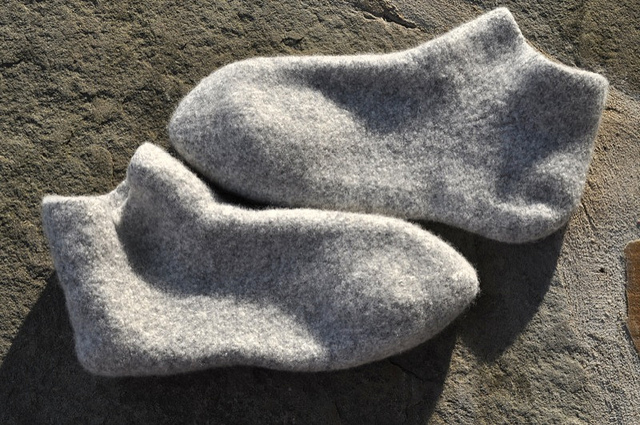
They are knit with a worsted weight feltable wool (like Cascade 220) on US 10.5 needles, which makes them very quick to knit. I usually use a 16” circ, so I don’t even have to mess with a small-circumference technique like DPNs (double-pointed needles), two circular needles or Magic Loop. The construction is identical to a traditional top-down sock so you can learn the process with great big comfy needles. And the best part? It doesn’t matter in the least if you mess up, because when you’re done… you felt the slippers.

knitting, sock knitting, felting, fuzzy feet.

Have you ever felted anything before? There is virtually no stitch definition left after the felting process so those wonky short rows to turn the heel? Those gusset stitches that you picked up that are a little loose and open? The kitchener stitch at the toe that isn’t quite perfect? Gone. All of it.

You wind up with a pair of comfortable, warm slippers. And you learned the mechanics of sock knitting! Even my uber-picky husband likes his Fuzzy Feet. He’s on pair #2, since he walked through his first pair by the end of Winter #3.

knitting, sock yarn, sock knitting, fuzzy feet, tutorial.

So what’s the next step after you’ve finished your Fuzzy Feet? I’ll be back to talk about that next time!

Forgetting Everything, Except This..

There is a mountain of laundry in the family room waiting to be sorted — seriously, a mountain.  And a mountain of dirty dishes collecting in the sink.  I suspect there are a few bills I’ve forgotten to pay too…    Real life has come to a complete halt while I get ready for the upcoming Pittsburgh Knit & Crochet show, and there are a lot of things that are getting pushed to one side — or getting forgotten altogether! — while that happens.


Yarn Drying in the Studio

But while I’ve been dyeing at rate to make my head spin, you’ll be pleased to hear that one thing I haven’t forgotten is…   to grab some of that yarn and put it in the shop for you guys!


Stella Fingering Weight Yarn in SeaFoam


Stella Fingering Weight Yarn in WinterBerries


Stella Fingering Weight Yarn in Plumberry

.

And just because it’s flippin’ FREEZING out there, I’ve included some Astrid DK too, which is incredibly soft and smooshy — perfect for lovely warm hats and gloves.  Stay warm, everybody!


Astrid DK Yarn in WinterBerries


Astrid DK Yarn in the Dept of Rocket Science

Scenes From a Fiber Life: Dyeing Like I’ve Never Dyed Before

When I blogged earlier this week that I’d been given a last minute chance to be part of the Pittsburgh Knit & Crochet Festival, I was feeling a little giddy.  I kept letting out sudden squeals so loud that I was frightening everyone around me.

Four days later, the giddy is still there.  The excitement is still there.  But you can add in a good dose of trepidation and a lot of tired too!  Because, this week, I’ve gone from my usual pace of dyeing about a dozen skeins a week to dyeing 20 skeins per day.  Wait — did you catch that?  From a dozen skeins per week to 20 per day…!  And I’m going to keep up that frenetic pace every single day for the next three weeks.  That’s how many skeins I need to get dyed, dried, reskeined, twisted, and tagged in order to have enough to do this show justice.  Tired?  I haz it!

.

But you know what?  For all that tired and all this crazy, there is an big upside — and that is that the studio is starting to look amazing!  There are skeins hanging everywhere, beautiful fibers draped along the walls, and vibrant colours beginning to fill the room…  It is absolutely the most wonderful sight on a bleak and cold January day.

And so, even as I am working my backside off, I am reminded that I love my job.  And that’s gotta be one of the best feelings in the world.

Of course, most of these skeins are headed to the show, but I’m going to grab a few of them and put them in the shop for you.  Keep an eye out for them early next week!